Showing posts with label resilience. Show all posts

Wednesday, 22 October 2014

October working bee at Rea Lands

A brilliantly sunny morning for the October bee. Rea Lands was looking spring-lush with deep rich greens and yellows & strong dark shadows against a cloudless sky as we gathered.

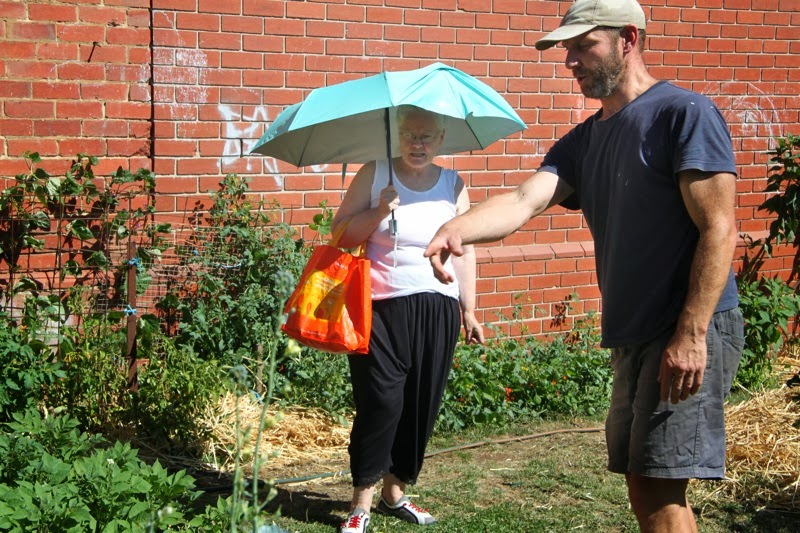
Sam, Ian, Evelyn
Overall the garden was looking good, but right away there was talk about the mulch heap along the back (neighbour Evelyn's) fence, particularly about some larger branches and the pieces of trunk embedded in the pile. There was concern that it looked almost looked like neglect… not the true story but not the message we want to send. Also in that state it wasn't breaking down (the intention) quickly enough, and could be a fire and snake hazard. By the end of the bee the trunks were rolled out and carried down the hill to be positioned as borders, and the larger branches were separated for later mulching. As well as addressing this, the morning was spent on general tidying, a bit of trimming and cutting back, and planting of donated seedlings and herbs throughout the garden.

... the heap!
... Peter, Sam, Lena
... another view of the heap
... Lena & Ayumi
... Jeremy & Sam
... Lena & Ayumi
... Peter
... some seedlings and herbs
... Chris

... Ayumi
... Maureen
... Tracey & Dora
... Saaci & chick
Over a picnic lunch various aspects of ongoing maintenance were talked about including the following: — regarding the use of macro-mulch throughout the garden it was decided that no branches be put along the very edge of beds as this is a problem for mowing, though long straight branches can be set in from the edges about half a metre and strawberries (for example) grown on the grass side of the branch. — as a general practice, only small sticks and branches should be used as mulch and then only if completely covered with grass, weeds, etc…so, no uncovered macro mulch. — any larger branches and cuttings to be put in a newly allocated spot at the end of the access lane from Hill Street (with thick ends aligned for easy handling to facilitate mulching by the Council.)

Tia, Jeremy, Saaci, Alison, Jasper, Arden, Lena, Sam, Peter, Chris, Maureen, Dora, Tracey
There was agreement that the following requests need to be made to council 1. mulching of branches and larger cuttings, with the wood chips left in a pile for use on the beds; 2. light pruning of the neighbouring oak tree (neighbour Noel spoke to us, and knows and approves) and chipping of the cuttings. 3. Grass from mowing to be either put directly onto beds or left in a heap for us to put on the beds (around trees). 4. Access road to be an all weather one by putting down some aggregate. 

A general decision was also made that Rea Lands reverts back over time to the original perennial garden and food forest concept… that future plantings should be long-living and self-propagating plants such as herbs, yarrow, strawberries, artichoke, nasturtiums, rhubarb, etc. also green manure crops like lupins, beans, peas, sweet peas, and summer ground covering plants such as pumpkins. The present veggies will be left to survive as long as they do. 

From this discussion a larger draft document has been prepared by Pete O'Mara seeking inputs from other DCFG-ers and the local community. Updates will be forthcoming... people who would like a copy of the overview document can email Pete directly

... top corner post-Peter!
... relocated trunks
... streamlined mulch along the back fence
... heavier macro mulch sorted for chipping
the orchard


During the day we noticed that our work was being watched over by magpies nesting in the Norfolk Island pine… 
the nest and one parent can just be seen in the middle of this pic!

this month's pics: Tia & Ian
October workers and visitors included Lena, Sam & Ayumi with Saaci (& baby chicks), Alison, Tia & Jeremy with Jasper & Arden, Tracey, Maureen, Dora, Evelyn & Manfred, Ian, Chris & Peter, Peter O, Rebecca & Siena, Lindy with Alice, Violet & Ginger...

NEXT BEE: SATURDAY 8 NOVEMBER ALBERT STREET


Monday, 10 February 2014

February working bee: a hot summer's day


The prospect of yet another 38°+ day kept the numbers down for our February working bee. The plan was primarily to get the garden mulched and thoroughly watered. Dora came early to avoid the heat, and was joined by Tony, Anita, Luke and Kate, with Edie and Isla, Jeff with Beatrice, and Ian.

Despite what is now an extended heatwave – with the average temperature since mid-January around 34-35° and very low rainfall – the garden is looking in remarkably good shape and in fact quite beautiful… huge thank-you's to all the volunteer waterers. Toward the end of the morning Jo showed up as did Yael with Akira and Essie, bringing some produce to share. Also Rebecca, a grateful user of the garden, who harvested some snow peas, chives, a few cherry tomatoes, broccoli and kale…
Below: the morning and the garden in pictures. (Next working bee: Saturday 8 March)


Thursday, 9 January 2014

New Year catch-up news #1: Skate Park path & plantings

It took a couple of sessions to put down the compacted sawdust path at the Skate Park...

George & Jobbo at work
Jobbo, Scotty & Geoffrey
... but it was completed just before Xmas and looks magnificent - big thanks to everybody who helped!


The path has now been augmented with some further plantings... perennials and most of the orchard are in, and some citrus trees will be added soon. This year will be about getting more people involved and holding some fun workshops. This garden is open to everyone, individuals and community groups alike to make their own!


Note: If anyone is able to whipper-snip directly behind the garden (on the south & west sides) during January/February, that would help ward off any roundup spraying by the council, while we're still working on getting those border areas matted and mulched.

Monday, 2 December 2013

Skate Park working bee 10am – 12 midday Wednesday December 11


There's an upcoming working bee at the Skate Park on Wednesday December 11 to put down a compacted sawdust path, and to install some weed matting around the baby wattle hedge plants. This will reduce the need for slashing those areas behind the fruit trees. We’ll get underway around 10am. We need about 10 people, but all welcome! Please bring shovels, old tent pegs and wheelbarrows.

This regular visitor (below) has been at us for a few weeks to get onto this, so let's make them happy!


Reminder: the next Albert Street working bee is Saturday December 14... 

Thursday, 13 June 2013

Our work recognised further afield...

Melbourne's wonderful resource organisation, Cultivating Community, has written a comprehensive report on our growing community food network. This is how they begin:
Anyone who has been involved with community gardens or urban public growing spaces will know the patience and compromise necessary to get a new project started. Without wishing to widen the city-country divide we’ve always suspected that things are “different out there”. We decided to head out to rural Victoria to investigate some unusually forward community garden and food projects. 
First off we headed to Daylesford where we had heard murmurs that a group of rural Victorians – frustrated at sluggish responses to environmental and health crises – had been taking matters into their own hands to rapidly expand their network of communal growing spaces. As soon as we stepped off the bus we were greeted by Meg Ulman and Patrick Jones, who have been instrumental in establishing the thriving and diverse network of Daylesford Community Food Gardeners (DCFGs). As well as being lovely hosts, they were kind enough to answer some questions and fill us in on the history of the project.


Read on here.

Tuesday, 19 June 2012

A five acre food forest?

Yes, we're still in the middle of planning a fourth community food garden, but in the meantime we are also talking to Daylesford Secondary College about the possibility of a fifth garden at the school. The edible, ecological and educational possibilities of this site are potentially huge.

L-R Dave Stephens, Robert Hewat, Veronica Pellet and Alexis Pitsopoulos. Photo: Patrick Jones
Last Friday a first meeting was arranged by Dave Stephens (local forest activist and future parent of the school) who invited Alexis Pitsopoulos (local forager, herbalist, locavore cook and edible weedsman), Robert Hewat (local botanist, parent), Patrick Jones (community food system activist, designer and poet) and Veronica Pellet (French WWOOFer) to look over the site. We look forward to working with the school.