This doc (made in Castlemaine) is a good reference resource for treating disease and infestations this winter.
From here.

Showing posts with label coddling moth. Show all posts
Showing posts with label coddling moth. Show all posts
Thursday, 3 May 2012

Monday, 12 March 2012
March Working Bee
Thank you to all 50 people who turned up on Saturday for our monthly working bee and the Harvest Swapmeet. With so many enthusiastic people it's no wonder we got so much done.
We extended the chalk wall to include a space to list all the jobs that still need doing.

We continued pruning the apple trees alongside the library.

Then we mulched all the branches and covered them in lime to get rid of the apple scab.

We dug up a hefty crop of potatoes.

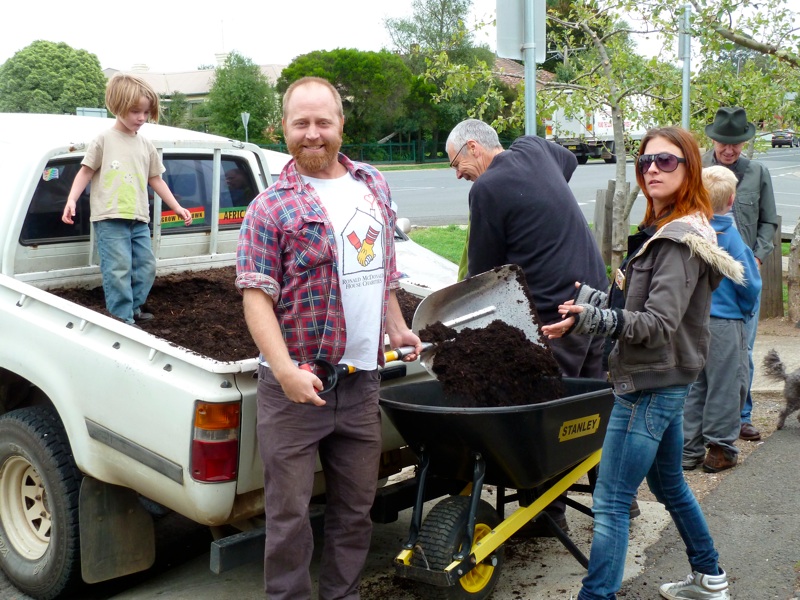
We dug in some donated mushroom compost. (Thanks Dougmore!)


We discussed the medicinal herb garden we are going to plant at Rea Lands Park. (If you'd like to be included in these discussions and plantings, please email us.)


We extended the chalk wall to include a space to list all the jobs that still need doing.

We continued pruning the apple trees alongside the library.

Then we mulched all the branches and covered them in lime to get rid of the apple scab.

We dug up a hefty crop of potatoes.

We dug in some donated mushroom compost. (Thanks Dougmore!)
We planted some seedlings.


We discussed the medicinal herb garden we are going to plant at Rea Lands Park. (If you'd like to be included in these discussions and plantings, please email us.)

We swapped goodies from our home gardens at the monthly Harvest Swapmeet.

And we marvelled at how lucky we are to live in a community with such abundance.

Tuesday, 28 February 2012
Managing the Apples
In 1999 community food gardener and poet-artist Patrick Jones planted a Granny Smith (as cross-pollinator) and eighteen Fuji apple trees around the Daylesford Public Library as part of a public artwork he called Poemscape: A Physical Anthology. Each tree was accompanied by a poem etched onto a plaque and fixed to a plinth he'd carved from local hardwoods. Three local poems, six Australian poems and twelve international poems all with ecological themes comprise the anthology. The Granny Smith was the title tree, and marks the first of nineteen physical pages each now sheltered by an established tree.

Over the past twelve years Patrick has fed, mulched, pruned, picked and watered them as they grew.
The trees have provided much free public food over the past decade but in the past few years with attacks by Sulfur Crested Cockatoos, apple scab (ascomycete fungus Venturia inaequalis) and coddling moth there has been little to no harvest. Community gardener extraordinaire Paul Dempsey and Patrick have been brainstorming ways to bring the yield back to town. And Paul's recent research determined a whole plan approach was needed. "We must make public fruit trees viable and productive if we are to attend to the coming food crisis and get council's backing to plant more", said Paul.
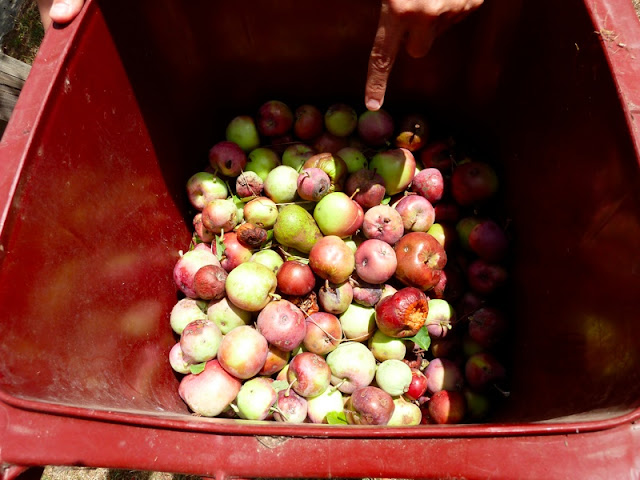
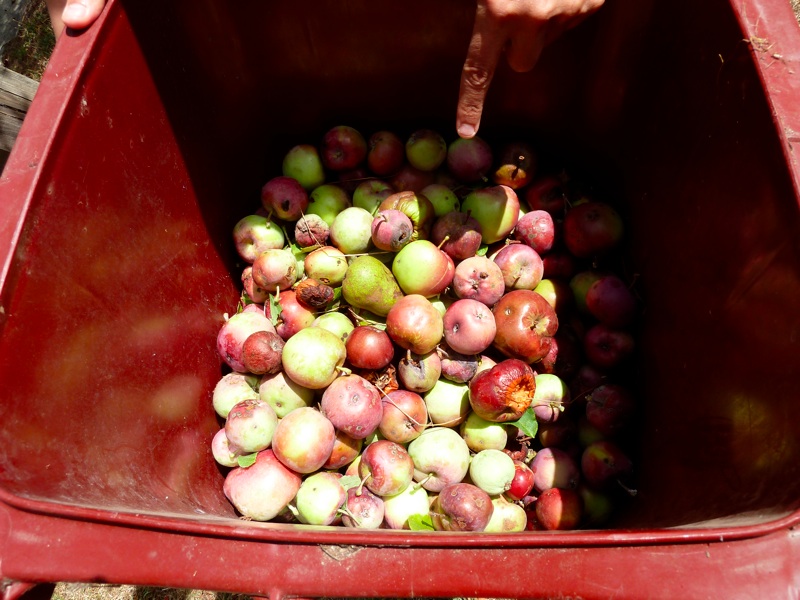
The first task was to remove all the fruit infected with coddling moth, which we did at the last working bee.

The apples went to feed Chris and Diane's (Spa Venison) pigs. Chris estimated there was half a tonne and no doubt the pigs would have enjoyed the extra protein from the moths.
Then last Saturday Patrick and Paul spent a blistering nine hours (on a 35 degrees day) pruning and chipping the trees to try to attend to the apple scab, which is a form of fungi. The first thing to do was to thin the trees to allow more airflow. Apple scab appears in humid conditions and as the last two summers have been particularly wet this problem has grown. Paul drove the pruning tools...

While Patrick drove his noisy wood chipper turning the wood and leaf prunings into mulch which was placed on the north side of the Albert St community garden to protect the plants inside the fence from harsh drying out.

The next day Paul attempted to spray all the trees with a lime/water solution, but it was a difficult task with nearby cars parked too close, wind howling and an extremely time consuming, fiddly job.

So this is where we got to. The next working bee is just around the corner (March 10) and there's more to be done. We need to cover up the pile of mulch so as the fungus doesn't spread and we will probably need to do a second, even more harsh prune to remove as much leaf as possible. This will assist us to spray lime onto a small leaf mass next year as well as net the trees from cockatoos and closely observe and remove any apples with coddling moth.

The Poemscape just planted in 1999.
Over the past twelve years Patrick has fed, mulched, pruned, picked and watered them as they grew.
The trees have provided much free public food over the past decade but in the past few years with attacks by Sulfur Crested Cockatoos, apple scab (ascomycete fungus Venturia inaequalis) and coddling moth there has been little to no harvest. Community gardener extraordinaire Paul Dempsey and Patrick have been brainstorming ways to bring the yield back to town. And Paul's recent research determined a whole plan approach was needed. "We must make public fruit trees viable and productive if we are to attend to the coming food crisis and get council's backing to plant more", said Paul.
The first task was to remove all the fruit infected with coddling moth, which we did at the last working bee.

Community gardeners Anthony Petrucci, Fiona Porter (up ladder) and Jasper Fullerton-Crane making the ladder steady.
Then last Saturday Patrick and Paul spent a blistering nine hours (on a 35 degrees day) pruning and chipping the trees to try to attend to the apple scab, which is a form of fungi. The first thing to do was to thin the trees to allow more airflow. Apple scab appears in humid conditions and as the last two summers have been particularly wet this problem has grown. Paul drove the pruning tools...

While Patrick drove his noisy wood chipper turning the wood and leaf prunings into mulch which was placed on the north side of the Albert St community garden to protect the plants inside the fence from harsh drying out.

The next day Paul attempted to spray all the trees with a lime/water solution, but it was a difficult task with nearby cars parked too close, wind howling and an extremely time consuming, fiddly job.

So this is where we got to. The next working bee is just around the corner (March 10) and there's more to be done. We need to cover up the pile of mulch so as the fungus doesn't spread and we will probably need to do a second, even more harsh prune to remove as much leaf as possible. This will assist us to spray lime onto a small leaf mass next year as well as net the trees from cockatoos and closely observe and remove any apples with coddling moth.
Subscribe to:
Posts (Atom)